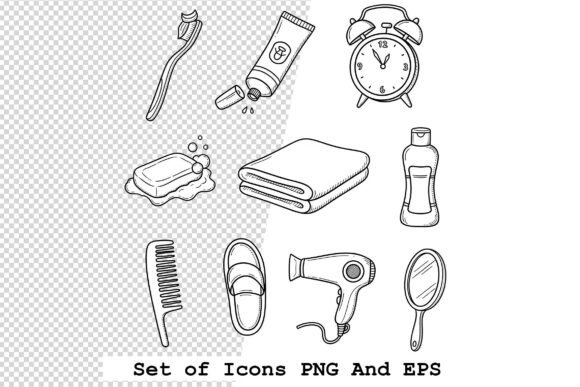
Daily Routine Icons Vector Set: A Design Asset Worth Using
If you have ever needed to represent morning habits, work tasks, or evening rituals visually, you know how quickly a small set of simple illustrations can shape an entire project. A Set of Daily Routine Icons Vector is exactly what it sounds like—a collection of clean, scalable icons designed to depict common daily activities. But beyond that simple definition, this type of asset solves a recurring problem: how to communicate routine actions clearly without cluttering your layout or confusing your audience.
Whether you are building an app, designing a presentation, or putting together a productivity planner, icons are one of the fastest ways to guide attention and reduce text. The right set does not just look good—it actually improves how people interact with your work.
What Makes a Daily Routine Icon Set Stand Out
Not all icon sets are created equal. When you evaluate a Set of Daily Routine Icons Vector, look for consistency in line weight, proportion, and visual style. A well-crafted set will feel harmonious across all its symbols, whether you are looking at an icon for waking up, brushing teeth, exercising, or working at a desk. This consistency matters because it lets you build a cohesive visual language without having to tweak each element individually.
Another quality worth noting is clarity. A strong icon does not rely on excessive detail to convey meaning. Instead, it uses recognizable silhouettes and universal symbols. For example, a coffee cup icon should be identifiable at a glance, even at smaller sizes. The same goes for a sleep icon, a meal icon, or a commute icon. When each graphic is stripped down to its essence, your audience processes information faster and with less cognitive effort.
Scalability is also a defining feature. Because these icons exist in vector format—typically EPS or PNG—they remain sharp and crisp whether you are using them on a mobile screen or a large poster. This flexibility alone makes them a practical choice for projects that span multiple platforms.
Why Consistency Matters in Real Projects
Imagine you are designing a habit tracker app. Your users will see icons for water intake, reading, meditation, and exercise all on the same dashboard. If each icon has a different stroke thickness or a slightly different style, the interface will feel disjointed. A unified Set of Daily Routine Icons Vector eliminates that problem by giving you a library of symbols that share the same visual DNA. You can drop them into your design and focus on layout and functionality instead of micromanaging each graphic.
Where You Can Use These Icons Daily
The practical applications extend far beyond mobile apps. Here are some realistic scenarios where a Set of Daily Routine Icons Vector adds real value:
Digital Products and Interfaces
If you are a web designer or app developer, you already know that icons are a core part of user experience. A daily routine icon set works well in productivity apps, wellness platforms, habit trackers, scheduling tools, and even educational software. You can use them for navigation menus, feature highlights, onboarding screens, or progress indicators. Because the set is vector-based, you can resize each icon without loss of quality, which is essential when adapting to different screen sizes and resolutions.
Print Materials and Planners
For bloggers, publishers, and educators who create printable planners, journals, or activity sheets, having a consistent icon library simplifies layout design. You can place icons next to each task or step in a routine, making the page easier to scan. Whether you are producing a morning routine checklist for a classroom or a weekly schedule for a coaching program, these icons add a professional touch without requiring custom illustration work.
Presentations and Infographics
If you regularly prepare slides or visual reports, you know how quickly text-heavy slides lose audience attention. Swapping out bullet points for relevant icons can make your message stick. A Set of Daily Routine Icons Vector gives you a ready-made visual vocabulary to map out processes, compare habits, or illustrate time management concepts. This is especially useful for coaches, consultants, and educators who need to explain routines clearly and quickly.
Social Media and Brand Content
Entrepreneurs and marketing professionals often need on-brand graphics for posts, stories, or ads. Using a consistent set of icons helps establish a recognizable visual identity. You might create a series of posts about daily productivity tips, each featuring a different routine icon. Over time, your audience will associate that visual style with your content, which strengthens brand recognition without extra effort.
Practical Benefits You Can Rely On
Choosing a Set of Daily Routine Icons Vector is not just about aesthetics. There are tangible benefits that affect how you work and how your audience responds.
- Faster design iteration: When your icons are ready to use and consistent, you spend less time searching for assets or adjusting sizes. You can drop them into your project and move on to higher-level decisions.
- Improved user comprehension: Icons reduce the amount of text people need to read. A well-placed symbol can communicate an action or concept in a fraction of a second, which speeds up interaction and reduces friction.
- Better accessibility: Paired with text labels, icons provide additional visual cues that help people with different learning styles or cognitive preferences navigate your content more easily.
- Consistent branding: Using the same icon family across your website, app, social media, and print materials creates a unified brand experience. This builds trust and professionalism.
- Easy customization: Vector files allow you to change colors, adjust sizes, and even modify shapes without degrading quality. You can adapt the set to match your brand palette or specific project needs.
Realistic Use Cases from Different Perspectives
Let me share a few examples from different roles to illustrate how this works in practice.
A freelance graphic designer might be hired to create a brand kit for a wellness coach. The coach wants a clean, approachable look for their website, printable guides, and social media templates. The designer selects a Set of Daily Routine Icons Vector that matches the brand’s tone, customizes the colors to fit the palette, and uses the icons consistently across all materials. The result is a polished, cohesive identity that the coach can manage on their own going forward.
A mobile app developer building a morning routine tracker needs icons for activities like waking up, stretching, drinking water, reading, and planning the day. Instead of designing each icon from scratch, they source a vector set that covers these actions. The development process speeds up, and the app interface feels polished from day one. Users respond well because the icons are intuitive and visually harmonious.
An educator or curriculum designer creating a digital course on time management for students can use the icons to represent each step of a productive morning routine. The icons appear in slide decks, handouts, and even interactive quizzes. Students find the material easier to follow, and the instructor saves hours of prep time.
What to Consider When Choosing a Set
Before you commit to any particular Set of Daily Routine Icons Vector, take a moment to evaluate a few practical factors.
- Coverage of activities: Does the set include the specific actions you need? Look for icons related to wakefulness, hygiene, meals, work, exercise, leisure, and sleep. The more relevant the library, the less you will have to supplement with custom graphics.
- File formats: EPS files are ideal for editing in vector software like Adobe Illustrator, while PNG files work for quick use in presentations or web projects. Having both gives you flexibility.
- Licensing and usage rights: Ensure the set allows commercial use if you plan to incorporate it into client work, products, or branding. Some sets restrict redistribution or require attribution.
- Customizability: Check whether the icons are easy to recolor, resize, or combine. A well-structured vector file with organized layers will save you time during customization.
- Style alignment: Consider whether the icon style fits your brand or project aesthetic. Minimal, clean designs tend to work well across most contexts, but it is worth verifying that the proportions and line weights match your other visual elements.
Observations from Working with Vector Icons
Over time, I have noticed that professionals who invest in a quality icon set early in a project tend to produce more polished work with fewer revisions. There is a reason for that. When you remove the friction of sourcing, resizing, and aligning graphics, you free up mental energy for layout, typography, and storytelling.
Another observation: users consistently respond better to interfaces and materials that use cohesive iconography. It is not about flashy visuals—it is about clarity and trust. A clean, minimal Set of Daily Routine Icons Vector communicates that you have paid attention to the details. That subtle signal of care can differentiate your work in a crowded market.
I would also recommend testing icons at multiple sizes before committing. An icon that looks great on a laptop screen may lose legibility when scaled down for a mobile button or a small print label. Vector formats make it easy to test this, so take advantage of that flexibility during your evaluation process.
Final Thoughts for Creatives and Professionals
Whether you are a seasoned designer, a business owner creating your first brand kit, or an educator putting together course materials, a Set of Daily Routine Icons Vector is a practical tool that saves time and improves communication. It is not about having the most elaborate illustrations—it is about having the right symbols, rendered consistently, so your audience understands your message without effort.
Look for a set that balances simplicity with recognizability, offers the formats you need, and aligns with the visual tone of your project. When you find that match, the icons become more than decoration. They become a functional layer of your design that guides, informs, and connects with people in a natural way.
The best part? You do not need to be an illustrator to use them effectively. With a quality vector set, you can achieve a professional, cohesive look across all your work—from apps to print to social media—and focus your energy on the ideas that matter most.